Introducing the UK Better Lives Index
 hallmarkfounda
on
October 3, 2025
hallmarkfounda
on
October 3, 2025
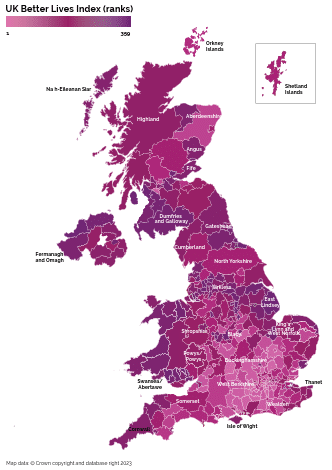
Spatial inequalities in health, wealth and opportunity across the UK are stark and persistent. A child’s life chances can vary dramatically depending on where they are born, with lasting impacts into adulthood and older age.
The ILC’s new UK Better Lives Index, supported by the Hallmark Foundation, brings together robust, UK-wide data to show the best and worst places to be born, grow up and grow old. It reveals how place continues to shape health, opportunity and ageing – and where change is most urgently needed.
In advance of launching the interactive online tool, the ILC has published initial findings and a short working paper summarising its approach to constructing the Index and showing how the findings relate to key policy priorities including: supply side growth and older workers, the Industrial Strategy and the NHS 10-Year Health Plan.
Key findings
Place shapes destiny
- Child poverty averages 12% in the top-ranked areas but 29% in the lowest – and over 40% in Oldham, Pendle and Bradford.
- Life expectancy at birth is nine years longer in Richmond upon Thames (85 years) than in Blackpool (76 years).
Unequal access to opportunity
- Households in the top 20% of areas have £10,000 more disposable income on average than those in the bottom 20%.
- Economic activity among over-16s is 11 percentage points higher in better-ranking places.
- House prices are more affordable in lower-ranked areas, but this often reflects stagnation rather than prosperity.
Inequalities in older age
- Economic inactivity among 50–64-year-olds averages 34.5% in the lowest-ranked areas – 13 points higher than in the top areas.
- Life expectancy at 65 is over two years longer in top-performing places (21 years vs 18.8). In Glasgow it is just 17 years.
- Avoidable mortality is almost twice as high in the bottom fifth of areas compared to the top.
- Pensioner poverty varies widely, with 39% of over-65s in Tower Hamlets claiming pension credit compared to just 4% in Hart.
Unlocking untapped economic potential
- Economic inactivity among older workers varies sharply, even between similar places, suggesting major growth potential.
- If all areas matched the best in their peer group, output from 50–64-year-olds could rise by 19% (£109bn).
- Even a modest scenario – where places meet the average of their peers – would boost output by 3% (£19bn).
- The largest proportional gains would be in struggling areas like Ashfield (+46%) and Burnley (+37%).
Towards an inclusive industrial strategy
- High-ranking areas are more likely to host frontier sectors such as digital and clean energy. In top areas, digital jobs make up 9.4% of employment, compared to 3.7% in the bottom fifth.
- Many lower-ranked areas are rooted in foundational industries such as steel, construction and logistics. These are vital but often overlooked in national policy.
- Without intentional design, the UK’s industrial strategy risks widening inequalities by reinforcing existing strengths. Growth must work for all people and places.
A UK-wide vision for health
- Between 2016 and 2021, over 550,000 excess deaths were linked to geographic inequality.
- England’s planned rollout of health hubs in deprived areas is welcome, but the Index shows Scotland, Wales and Northern Ireland face similar challenges. A pan-UK health and ageing strategy is essential.
The promise of potential
The UK Better Lives Index is not just a diagnosis – it is a roadmap for action. It shows where inequality is entrenched, but also where strengths can be built on. With the right investment and attention, every community has the potential to support longer, better lives.
See the report: ILC-UK-Better-Lives-Index.pdf